Visiting Sitt Zumurrud Khatun’s Mausoleum, 2026 updates.
Sitt Zumurrud Khatun’s mausoleum & the mosque and tomb of Sheikh Maarouf al-Kharkhi
One of Baghdad’s striking central landmarks is the elegant mausoleum of Sitt Zumurrud Khatun. Sometimes described as one of the capital’s most important pieces of architecture, the mausoleum lies in one corner of a sprawling cemetery near the mosque and tomb of Sheikh Maarouf al-Kharkhi.
Baghdad’s current rapid redevelopment has unfortunately not taken into account the value of some of its unique historic landmarks, including this wonderful mausoleum, which now has a flyover running unpleasantly close to it.
The sole benefit of this to tourists is that it is now easier to visit the mausoleum than it used to be, as you no longer have to rouse the key-holder to gain entry, and the dodgier parts of the area have not been just been cleaned up but removed altogether. Unfortunately, the builders of the road made the dubious “contribution” to the local area by unsympathetically repainting the outside of mausoleum and building a high modern wall around the cemetery.
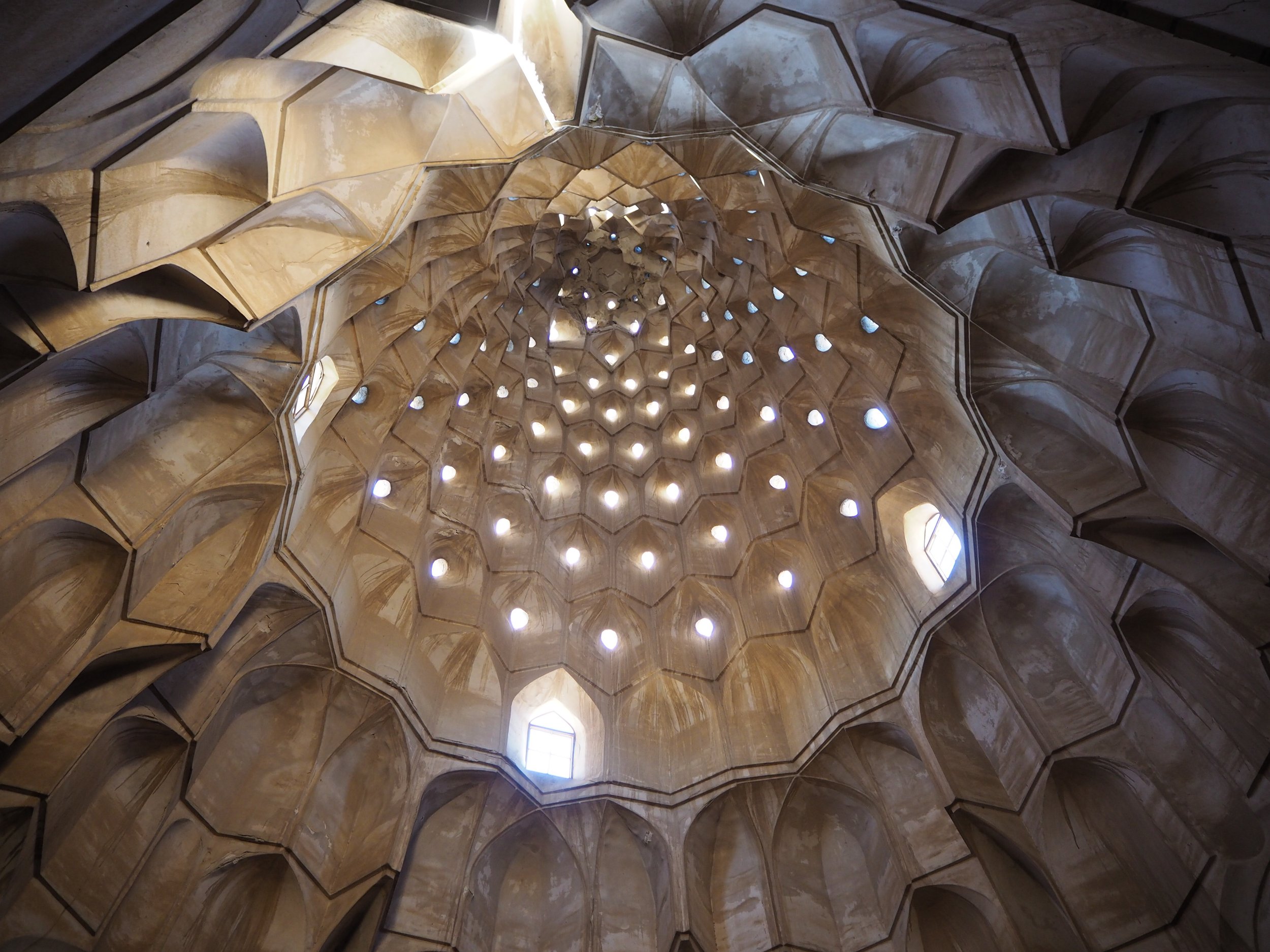
Sitt Zumurrud Khatun (the wife of one Abbasid Caliph and the mother of another) oversaw the construction of this - her own mausoleum - amongst other architectural projects in Baghdad. The result is stunning, especially from inside, where dappled sunlight falls in through the tiny windows embedded in its unusual nine-layered muqarnas (ornamental vaulting in Islamic architecture) dome, which “transforms itself from an octagon into a 16-sided figure and back again.” (1)
It may be possible (with the key-holder’s permission) to make the steep climb up the mausoleum’s narrow steps to the base of the conical dome, although care should be taken if making this ascent. To do so, you would still need to find the key-holder, who speaks almost no English. The family who have long acted as custodians for the site still currently live beside the mausoleum entrance, but for how much longer remains to be seen.
The views from here have changed dramatically over the past few years and the new flyover remains a serious blight on the visual landscape. Nevertheless, it affords decent views over the city, and the key-holder can point out the area towards the train station where hundreds of unknown Iraqis were hastily buried, without headstones, during the chaos and unrest which followed the 2003 US-led invasion of Iraq.
The mausoleum is treated as a sacred pilgrimage site by some visitors, so women may find it respectful to wear a headscarf, although we understand this isn’t obligatory. If there are plastic chairs near the cemetery gate, be particularly quiet and respectful, as it likely means there’s a funeral underway.
We always suggest also visiting the shrine of the 9th century Sufi mystic and saint Sheikh Maarouf al-Karkhi. This is a wonderful, unusual mosque, built in a daring futurist architectural style, expanding and replacing a former 13th-century Abbasid structure.
The elegant mosque and , unique tranquil atmosphere and pleasant views over the cemetery and towards Sitt Zummurud’s mausoleum (despite the flyover), makes it well worth a visit.
Modest attire is required for both men and women at the Sheikh Maarouf mosque, and women should wear a headscarf and abaya.
Women should not enter the shrine through the main doors but should veer left, walking around the outside of the building and entering the shrine through a separate door. A wooden screen separates the male and female sections.
(1) From Iraq: the Ancient Sites & Iraqi Kurdistan, published by Bradt.